Bell Jars and Glass Domes: Styling Butterflies and Beetles at Home
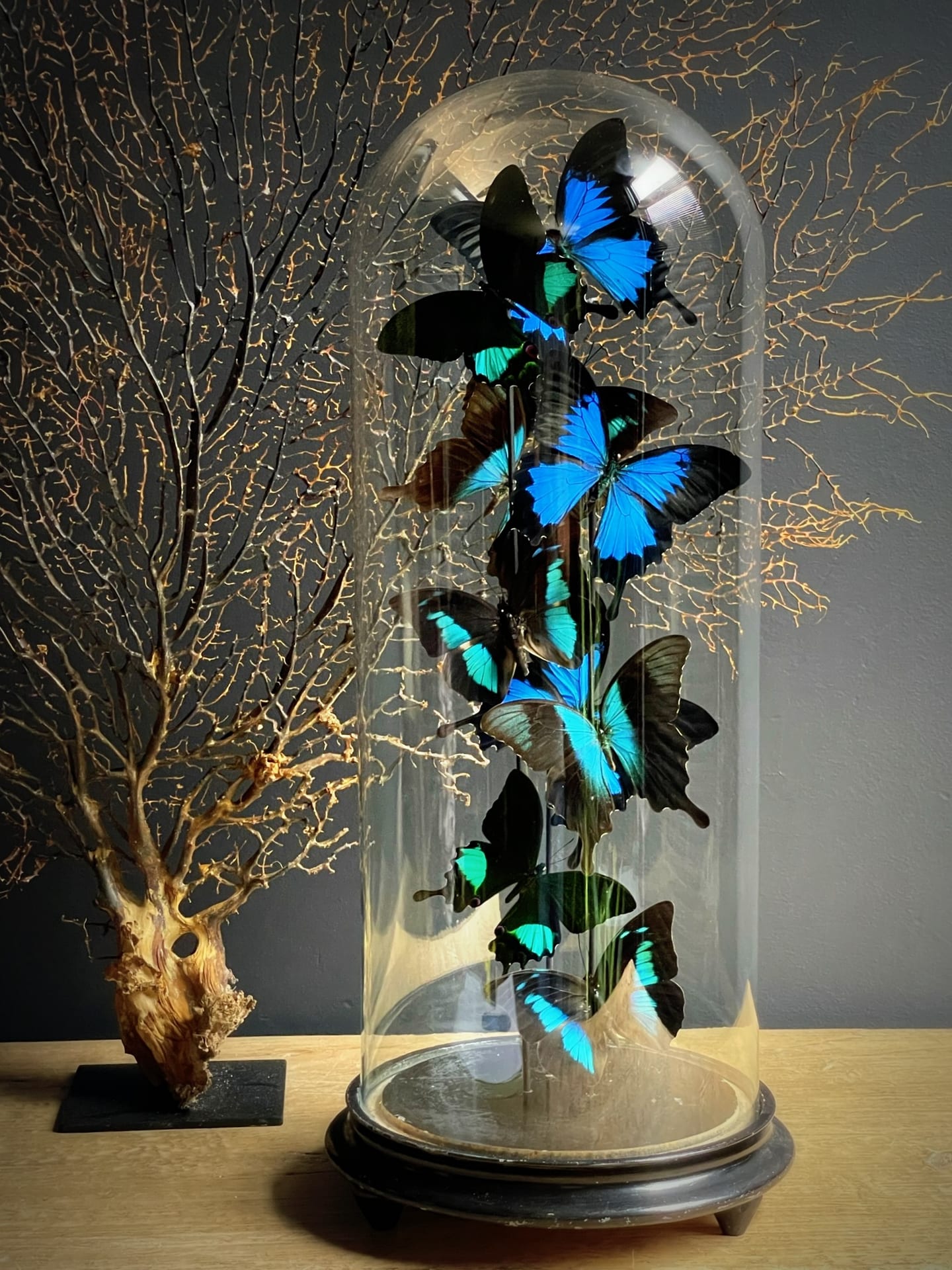
If there is a single object that converts people to natural history decor, it is the glass dome. It is small, it is sealed, it costs a fraction of a mounted animal, and it asks nothing of you but a shelf.
It is also the most forgiving thing in this category to style. Here is how to choose one, where to put it, and what separates a good dome from a tourist-shop one.
Why the dome works so well
A dome does three useful things at once.
It frames. The glass creates an edge, and anything inside an edge reads as deliberate. The same butterflies loose on a shelf would read as clutter.
It protects. Sealed glass keeps out dust, humidity swings and — critically — the museum beetles and moths that destroy unprotected specimens. A domed piece needs essentially no maintenance, which is not true of an open mount.
It scales down. Most people cannot place a full mount in a flat. Almost anyone can place a 30 cm dome. That is why we recommend it as the first purchase in the main guide to taxidermy in interior design.
What goes under glass
The category is broader than butterflies.
Butterflies are the obvious entry point — the colour does the work, and blue morphos in particular carry a room. Look for specimens with intact antennae and no tears at the wing edges.
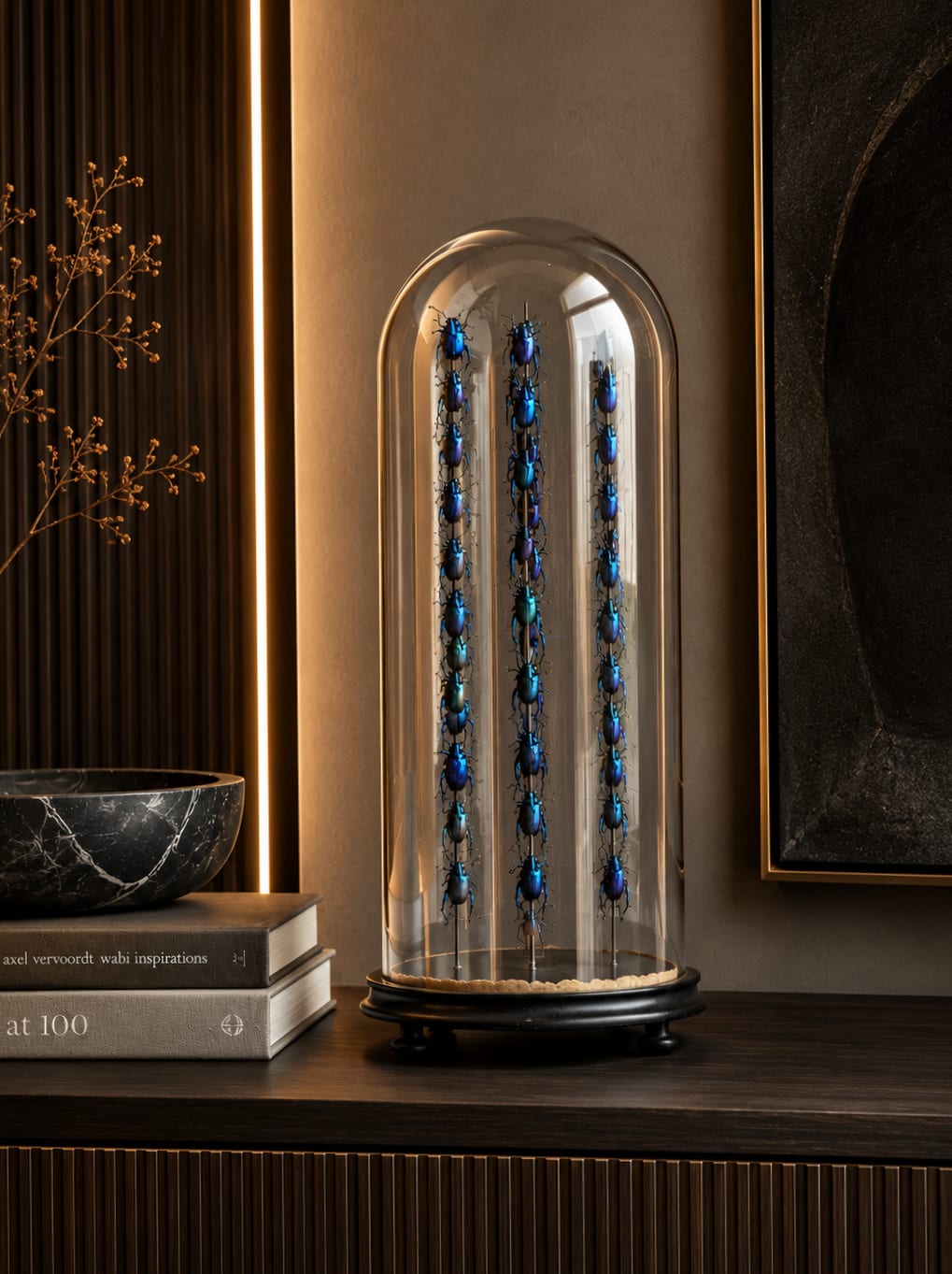
Beetles are, to many collectors, the better object. Iridescent species shift colour as you move past them, which is something a photograph cannot convey and a flat frame cannot exploit. A dome of mixed metallic beetles is quietly spectacular under a spot.
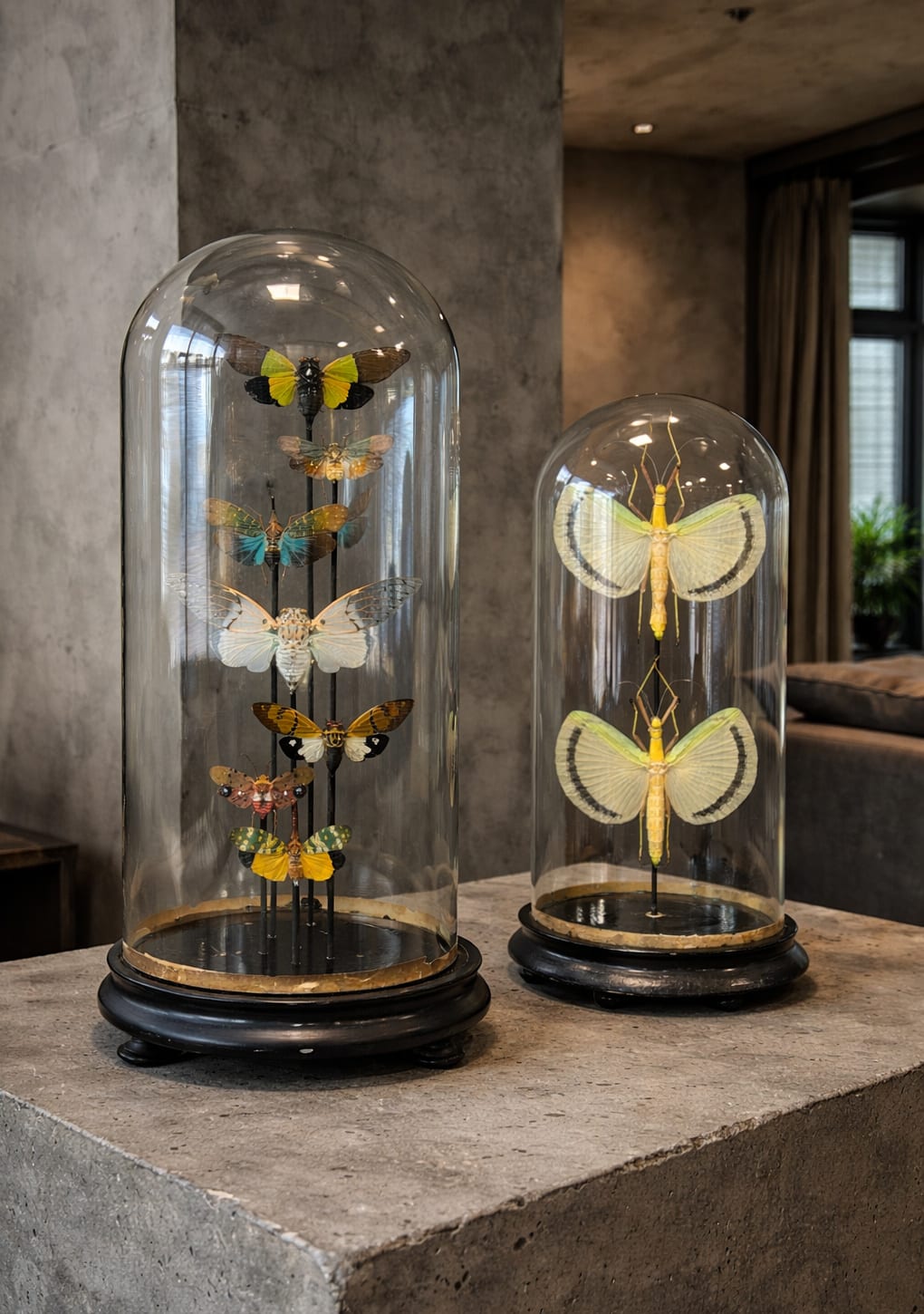
Mixed insect arrangements and antique entomological cases have the strongest cabinet-of-curiosities character, especially where the original hand-written labels survive. Those labels are part of the value — never remove them.
Small vertebrates, shells, corals and curiosities also appear under domes. Browse what is currently under glass in butterflies and beetles, and the wider naturalia and replicas and casts categories.
Judging quality
Five things separate a good dome from a bad one, and you can check all five from photographs.
- Are the specimens set symmetrically? Wings should be level with each other and set at a consistent angle. Uneven setting is the clearest sign of rushed work.
- Is there damage at the edges? Chipped wing margins, missing antennae or detached legs all significantly reduce value.
- Is the base proportionate? A base that is too shallow makes the dome look unstable; too tall and it dominates. Turned hardwood or ebonised bases are traditional and usually correct.
- Is the glass old or new? Antique glass has slight waves and occasional small bubbles. Perfectly flat, optically clean glass on a piece sold as antique means the dome is a replacement — not fatal, but it should be reflected in the price.
- Is the seal intact? Ask directly. A dome that does not seal will admit dust and pests, and the whole advantage is lost.
Placement and grouping
Domes are close-viewing objects. Placing one across a large room wastes it — the iridescence and the fine detail only work within a couple of metres.
Put them where people pause. Shelves beside a chair, a console in a hallway, a bookcase at eye level, a desk. Not on top of a tall wardrobe.
Group in odd numbers, vary the heights. Three domes of different heights on one shelf look composed; two identical ones look like a pair of bookends. If your domes are all the same height, raise one on a stack of books.
Give each one a plain background. A dome against a busy wallpaper disappears. Against a plain dark shelf back, it reads instantly.
Leave clear space around them. Roughly one dome-width of empty shelf on either side. This is the single easiest way to make a small object look valuable.
Lighting
Glass and iridescence both depend entirely on light direction.
The best result comes from a small spot mounted above and slightly in front, angled down at about 30 degrees. This lights the specimens without throwing your own reflection across the glass.
Avoid lighting from directly in front — you will see the room reflected rather than the contents. Avoid backlighting for beetles specifically, as it kills the metallic shimmer that is the whole point.
Warm light at 2700K suits antique bases and brass fittings. Keep the fixture far enough away that it does not warm the glass; a sealed dome that heats and cools repeatedly will eventually develop internal condensation.
And keep domes out of direct sunlight without exception. Butterfly pigments are among the most light-sensitive materials in the house — a blue morpho in a sunny window will visibly fade within a couple of years. This applies across the category, and it is covered fully in how to care for taxidermy.
Cleaning without damaging anything
The glass is the only part you should ever touch.
Clean the outside with a barely damp microfibre cloth, and dry it immediately. Never spray glass cleaner at a dome — the liquid runs down to the seal, wicks inside, and stains the base or the specimens.
Do not open a sealed dome to dust the contents. Insect specimens are extraordinarily fragile; antennae break from a breath of air, and wing scales lift off on contact and never go back. If the inside is genuinely dirty, that is a conservator’s job, not a Saturday’s.
Wipe the base with a dry cloth only.
Are they legal?
For the overwhelming majority of insect specimens, yes, with no paperwork required. Common butterfly and beetle species are widely and legally traded, and many are farmed specifically for the trade in a way that supports habitat conservation.
The exceptions are real but narrow: a small number of protected butterfly species, most notably some birdwings, are CITES-listed and require documentation. Antique cases occasionally contain protected species collected long before those rules existed, which changes what is needed to sell them legally.
If a dome contains anything beyond common species — particularly birds, reptiles or anything sold as rare — ask for the paperwork before you buy. Our guides to buying taxidermy legally and ethically and CITES and Article 10 certificates cover exactly what to ask for.
Frequently asked questions
How much should I expect to pay? Small single-species domes start modestly; large antique cases with original labels and rare specimens go considerably higher. Condition and originality drive price more than size.
Will the colours fade? Not meaningfully if kept out of direct sun and away from strong UV. Butterflies are more vulnerable than beetles.
Can I make my own arrangement? Yes, and framed kits exist, but setting insects well is a genuine skill. Buy a good one first and see how it is done.
Do they work in a modern interior? Better than almost anything else in this category. A dome is small, sculptural and colour-neutral apart from the specimens themselves.
See what is available now in butterflies and beetles, browse the full collection, or contact us for photographs of anything you are considering.